


Clutter rarely appears all at once.
It builds quietly. One drawer. One Amazon package. One “I might need this someday” at a time.
Then one day you look around your home and realize your space feels less like a sanctuary and more like a storage unit with decorative pillows. 🫠
If you’ve been wanting to simplify your life but feel overwhelmed by where to start, you are not alone. Decluttering can feel emotionally exhausting, mentally draining, and surprisingly difficult.
The good news?
You do not need to become an extreme minimalist overnight. You do not need to throw away everything you own. And you definitely do not need matching beige storage baskets blessed by Pinterest monks.
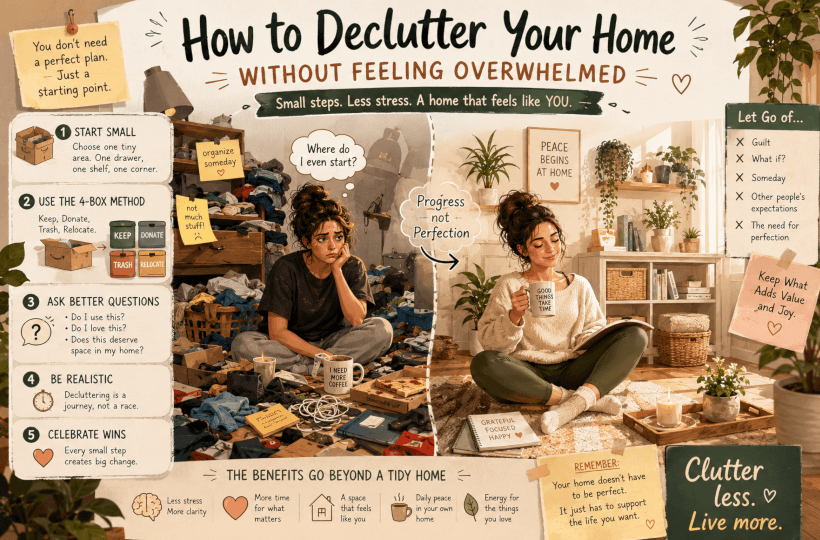
You just need a starting point.
This guide will show you how to declutter your home step-by-step without burnout, guilt, or overwhelm.
Why Decluttering Feels So Hard
Before you organize a single shelf, it helps to understand why clutter becomes emotionally heavy in the first place.
For many people, clutter represents:
- delayed decisions,
- emotional attachment,
- guilt,
- identity,
- fear of waste,
- or anxiety about the future.
Research from UCLA Center on Everyday Lives of Families found that excessive household clutter can increase stress levels, especially in women. Clutter constantly signals unfinished tasks to the brain, creating mental fatigue and overstimulation.
In other words:
your home may be physically crowded and mentally noisy at the same time.
That’s why decluttering often feels bigger than “just cleaning.”
What Is Decluttering Really About?
Decluttering is not about owning as little as possible.
It is about creating space for what actually matters.
A clutter-free home can help create:
- less stress,
- easier cleaning,
- better focus,
- calmer mornings,
- improved productivity,
- and more intentional living.
Minimalism is not the goal.
Intentionality is.
How to Start Decluttering When You Feel Overwhelmed
The biggest mistake people make is trying to transform their entire house in one weekend.
That usually ends with:
- giant messes,
- decision fatigue,
- frustration,
- and donation piles haunting your hallway for three months.
Instead, start small and build momentum.
1. Start With One Tiny Area
Choose:
- one drawer,
- one shelf,
- one nightstand,
- or one bathroom cabinet.
Small wins create psychological momentum.
Completing a tiny decluttering task gives your brain a reward signal that makes continuing easier.
Avoid starting with:
- the garage,
- the attic,
- sentimental storage,
- or “the chair” covered in clothing archaeology.
Those are advanced-level boss battles. 🎮
2. Use the “Keep, Donate, Trash” Method
As you sort through items, place them into three simple categories:
Keep
Items you genuinely use, need, or love.
Donate
Items in good condition that no longer serve your life.
Trash
Broken, expired, damaged, or unusable items.
Simple systems reduce decision fatigue.
The more complicated your decluttering method becomes, the easier it is to quit halfway through.
3. Ask Better Questions
Instead of asking:
“Could I ever possibly use this someday?”
Ask:
- Do I actually use this now?
- Would I buy this again today?
- Does this improve my daily life?
- Am I keeping this out of guilt?
- Am I keeping a fantasy version of myself?
That last one hits like a folding chair sometimes.
Many people store:
- hobby equipment they never touch,
- clothes for a future body,
- books they feel they should read,
- or gadgets purchased during a temporary identity crisis at 2 a.m.
Decluttering often means letting go of unrealistic expectations too.
How to Declutter Sentimental Items Without Guilt
Sentimental clutter is usually the hardest category.
Photos, gifts, childhood items, and inherited belongings carry emotional weight far beyond their physical size.
Here’s the important distinction:
The memory is not inside the object.
The object simply triggers the memory.
That means you can preserve meaning without preserving everything.
Try:
- keeping a few meaningful pieces instead of entire boxes,
- photographing sentimental items before donating,
- digitizing old photos and documents,
- creating a small memory container with intentional limits.
You do not honor memories by drowning them in storage bins.
The “Someday” Trap That Creates Clutter
One of the biggest causes of clutter is the belief that:
“Someday I’ll use this.”
Someday clothing.
Someday craft supplies.
Someday workout equipment.
Someday kitchen gadgets.
But “someday” often becomes permanent storage.
If you have not used something in years and realistically would not buy it again today, it may be time to let it go.
Minimalism is less about removing things and more about removing distractions.
How to Declutter Your Home Gradually
Not everyone wants a dramatic weekend purge.
If you prefer a slower approach, try the “1% method.”
Every day:
- remove one item,
- organize one shelf,
- clear one surface,
- or fill one donation bag.
Tiny consistent actions create massive long-term results.
This approach works especially well for:
- busy parents,
- people with ADHD,
- emotionally overwhelming spaces,
- or anyone who burns out easily.
Progress counts even when it is slow.
Decluttering Tips That Actually Make a Difference
Here are a few high-impact decluttering habits:
Stop Bringing in More Stuff
Decluttering while constantly shopping is like brushing your teeth while eating Oreos.
Consumption habits matter.
Before buying something, ask:
- Do I truly need this?
- Where will it live?
- What problem does it solve?
- Will I still care about this next month?
Clear Flat Surfaces First
Counters, desks, and tables create immediate visual stress when crowded.
Clearing visible surfaces creates quick emotional relief.
Create “Enough”
Many homes are filled with duplicates:
- extra mugs,
- backup blankets,
- mystery cables,
- twenty-seven reusable tote bags reproducing in darkness.
You probably do not need twelve versions of the same thing.
Avoid Perfectionism
A perfectly organized home is not the goal.
A functional, peaceful home is.
Perfectionism often prevents progress entirely.
Done beats perfect.
Every time.
Benefits of Decluttering Your Home
People often expect decluttering to change their house.
What surprises them is how much it changes their mind.
Many people report:
- lower stress,
- improved focus,
- better sleep,
- reduced anxiety,
- increased productivity,
- and stronger emotional clarity.
Decluttering creates fewer visual interruptions competing for your attention.
Your environment affects your nervous system more than most people realize.
Minimalism Looks Different for Everyone
There is no universal rulebook for minimalism.
Some people love:
- books,
- art,
- music collections,
- cozy decor,
- or meaningful keepsakes.
Minimalism is not about deprivation.
It is about intention.
Your home should support your life, not silently exhaust you.
Final Thoughts: Start Before You Feel Ready
Many people wait for:
- more time,
- more motivation,
- the perfect plan,
- or the magical energy burst that never arrives.
But clarity usually comes after action, not before it.
Start with one drawer.
One shelf.
One decision.
Because decluttering is not really about getting rid of things.
It is about creating room for a calmer, lighter, more intentional life.
And that future does not begin someday.
It begins today.